What RTP means
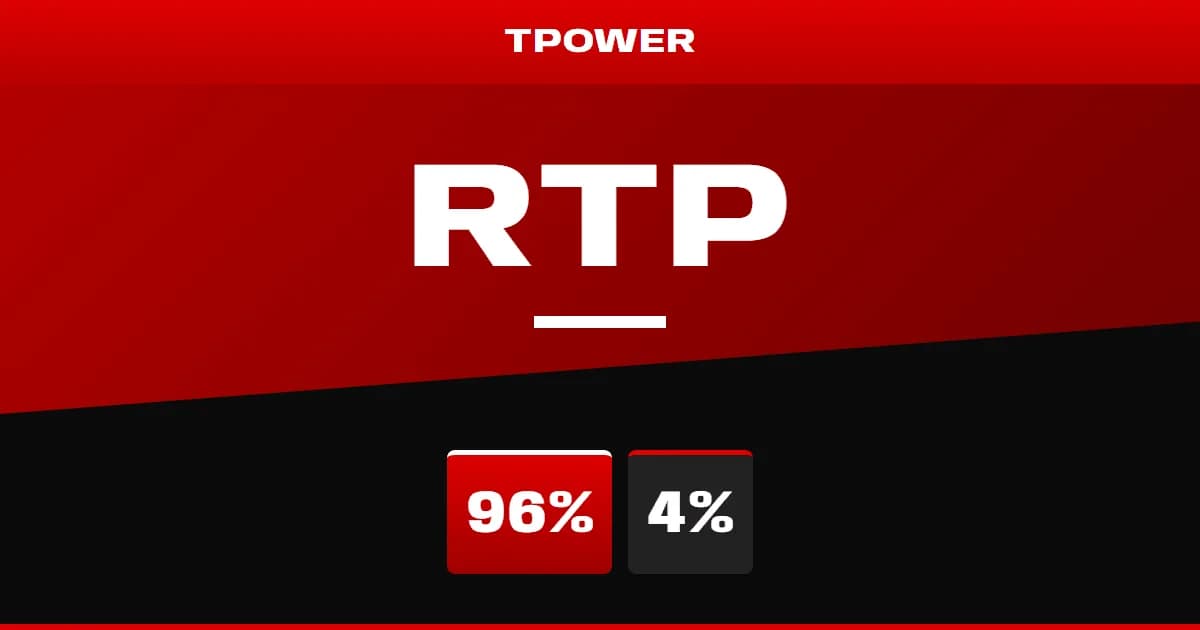
RTP, short for return to player, is a percentage worked out from a slot's design: its paytable, its features and the weighting of the symbols on each reel. It states how much of all the money staked on the game it will pay back, on average, over its lifetime. A slot with an RTP of 96% is built to return RM96 of every RM100 staked on it, counted across every player and every spin, usually millions of them.
Three details are easy to miss:
- It is theoretical. RTP comes from the game's maths, not from recent results. It does not drift up after a quiet day or down after someone wins big.
- It counts returned stakes. On a winning spin, the payout includes your bet coming back. A RM1 spin that "wins" RM0.60 has returned 60 sen and cost you 40.
- It is measured on money staked, not money deposited. The next section shows why this matters most.
The house edge is the other side of RTP: 100% minus the RTP. A 96% game has a 4% house edge.
RTP and the house edge, worked through
1,000 spins of RM1 at 96%
Say you play 1,000 spins at RM1 each on a game with an RTP of 96%.
- Total staked: 1,000 × RM1 = RM1,000.
- Average returned: 96% × RM1,000 = RM960.
- Average cost: RM1,000 − RM960 = RM40, or 4 sen a spin.
That RM40 is an average across a great many sessions like yours. Your own 1,000 spins will almost certainly land somewhere else, as the sections below show.
Why turnover is bigger than your deposit
Now say you deposit RM100 and keep replaying whatever comes back, at RM1 a spin. The RM100 pays for the first 100 spins. On average RM96 comes back from them, which pays for about 96 more spins, and so on. If you play until the balance is gone, the total you stake is, on average, about RM100 ÷ 4% = RM2,500.
In other words, a RM100 budget played to the end means, on average, around 2,500 spins of RM1, not 100. The house edge works on all of it, which is how a small percentage empties a balance: 4% of RM2,500 is the whole RM100.
Small differences in RTP add up
Here is the average cost of staking RM1,000 at three RTPs:
- 97% RTP: RM30.
- 96% RTP: RM40.
- 94% RTP: RM60.
The gap between 94% and 97% looks like three points, but the 94% game costs twice as much to play over the long run. Where two games show their RTP and you enjoy both, the higher figure is the cheaper one.
What an hour of play costs
Multiply three numbers: spins per hour, bet per spin and house edge. Say you play RM0.50 spins at about ten a minute. That is 600 spins and RM300 staked an hour. At 96% RTP the average cost is 4% of RM300, or RM12 an hour; at 94% it is RM18. Double the bet or the pace and the cost doubles too. It is the most honest way to look at a slot session: a price per hour, paid on average, for the entertainment.
Volatility and hit frequency
RTP tells you how much a game pays back in the long run. Volatility tells you how it pays it back: in many small amounts or a few large ones. Hit frequency is the part of that you can see from spin to spin.
Hit frequency
Hit frequency is the share of spins that return anything at all. A hit frequency of 25% means that, on average, one spin in four pays something. It is not the chance of making a profit on a spin, because many hits pay back less than the stake. A game can hit often and still drain a balance steadily, 60 sen at a time.
Two games with the same 96%
Take two simplified games, each played at RM1 a spin:
- Game A pays on one spin in three, and every win pays RM2.88. Average return per spin: RM2.88 ÷ 3 = RM0.96. RTP 96%.
- Game B pays on one spin in 500, and every win pays RM480. Average return per spin: RM480 ÷ 500 = RM0.96. RTP 96%.
Now play 100 spins on each, staking RM100.
- Game A: expect about 33 wins. About three sessions in four return between RM80 and RM110.
- Game B: about four sessions in five return nothing, because the chance of no win in 100 spins is 499/500 raised to the power 100, roughly 82%. About one session in five wins at least once and returns RM480, occasionally more.
Same RTP, the same RM4 average cost per RM100, and completely different evenings. Real slots sit between these extremes and mix many prize sizes, but the principle holds: volatility is about the shape of the results, not their average.
Reading volatility from the paytable
Some games show a volatility rating in their info screen; many do not. You can still read the signs:
- A very large top prize, often shown as a maximum win of so many times your bet, means a big share of the RTP is saved for rare results.
- A wide gap between what the top symbol and the low symbols pay points the same way.
- Features that carry the game, such as free spins with climbing multipliers, usually mean quieter stretches in between.
- Small, frequent line wins and modest features point to a calmer game.
Why one session rarely looks like the RTP
A feature can hold a large share of the RTP
Say a game's 96% is made up of 66% from ordinary line wins and 30% from a free-spins feature that triggers, on average, once every 150 spins. For the feature to contribute 30%, the average round must pay 0.30 × 150 = 45 times your bet.
Now play 100 spins. The chance of never triggering the feature is 149/150 raised to the power 100, about 51%. So in roughly half of all 100-spin sessions, the game returns something closer to 66% than 96%. The other half include at least one feature, and some of those finish well ahead. Averaged across all of them, the figure comes back to 96%.
The swing grows more slowly than the edge
Statisticians measure the spread of results with the standard deviation. For Game B above, it works out at about RM21 per RM1 spin; for Game A, about RM1.36. As you add spins, the expected loss grows in step with the number of spins, while the spread grows only with its square root.
- Game A, 1,000 spins: expected loss RM40, typical swing about RM43 either way.
- Game B, 1,000 spins: expected loss RM40, typical swing about RM680 either way.
- Game B, 1,000,000 spins: expected loss RM40,000, typical swing about RM21,000.
Multiply the spins by 1,000 and the expected loss grows 1,000 times, while the swing grows only about 32 times. That is why a volatile game feels like pure luck to one player, while across the many millions of spins played by everyone, its results settle close to its RTP.
Most sessions finish below the average
In a volatile game, a few large wins pull the average up, so most individual sessions finish below it. In Game B, the average return over 100 spins is RM96, but by far the most common result is RM0.
How to find a game's RTP
- Open the game and tap the information button, usually marked "i", "?" or a menu icon.
- Look through the rules or game-info pages, often right to the end. The figure may be labelled RTP, return to player, theoretical return or expected payback.
- Note whether more than one figure is listed. Some games give a separate RTP for an optional feature, or show how much of the RTP comes from a jackpot.
If a game does not show an RTP, you cannot know it. Some providers release the same game at more than one RTP setting, so a figure from another source may describe a different version from the one in front of you. For the other things worth checking in that screen, see our 918KISS beginner's guide.
Why no system beats RTP
Every spin is decided by a random number generator the moment you press the button, and the result does not depend on earlier spins, the time of day or how long you have been playing. That leaves three things you control: how much you bet, how many spins you play and which game you choose. Betting systems rearrange the first and change nothing else.
- Changing your stakes does not change the edge. Play 500 spins at RM1 and then 100 at RM5: that is RM1,000 staked, and at 96% the average cost is RM40, exactly the same as 1,000 spins at RM1. The expected loss is always the total staked times the house edge, whatever order the bets come in.
- Doubling after a loss escalates fast. Start at RM1 and double after every losing spin: after six losing spins in a row you have staked RM63 and your next bet is RM64. On a game where seven spins in ten pay nothing, six losing spins in a row happens about 12% of the time. And many slot "wins" pay back less than the stake, so they do not even end the sequence.
- Switching games does not reset anything. Moving from a "cold" game to another changes only which RTP and volatility you are playing.
In practice, the cost of playing is set by your total stake and the game's RTP. Smaller bets, fewer spins and, where it is shown, a higher RTP all lower it. Nothing makes it zero.
Using RTP and volatility to plan a session
- Price the session first: bet × spins per hour × house edge gives the average cost per hour.
- Match volatility to your budget. On a small budget, a calm game or a smaller bet keeps you playing longer; a volatile game needs enough budget for many spins before its features land.
- Set a loss limit and a time limit before you start, and stop at whichever comes first.
- Decide what you will do with a win before it happens.
The slots lobby lists every provider on TPOWER, from 918KISS to JILI. Deposit and session limits, breaks and self-exclusion are explained on our responsible gaming page, and responsible gaming in Malaysia covers warning signs and where to find help. TPOWER is for adults aged 18 and over.
Frequently asked questions
Does the RTP change with my bet size?
In most slots, no: prizes scale with the bet, so the percentage is the same at every level. Where a game treats bet sizes differently, for example if only some bets qualify for a jackpot, its rules page explains how.
What is the difference between RTP and hit frequency?
RTP is how much of all money staked comes back over the long run. Hit frequency is how often a spin returns anything. A game that hits on a third of its spins can still return less than one that rarely hits, because many hits pay less than the stake.
Is a high-volatility slot better for a big win?
It is built to make large wins possible, at the price of long quiet stretches, but volatility does not change the average: two games with the same RTP cost the same on average. On a small budget, the likelier result is that the budget runs out before a big feature lands.
Can a slot’s RTP change with the time of day?
No. A game does not adjust itself to recent results or to the clock. Its RTP comes from its paytable and reel settings, which is why no time of day is a better time to play.
Why do I seem to lose more than the RTP suggests?
Because the average includes rare large wins. In a volatile game, most sessions finish below the average and a few finish far above it, so the result you see most often is the below-average one.